Archives
-
JOURNAL OF SCIENCE, TECHNOLOGY & ENTREPRENEURIAL ECOSYSTEMS DEVELOPMENT (KU-JSTEED)
Vol. 1 No. 2 (2024)Kugona-Ukwenelisa: Journal of Science, Technology and Entrepreneurial Ecosystems Development (KU-JSTEED), accepts original research that advances the tenets of the heritage-based Education 5.0 philosophy with a primary focus on the production of goods and services. The journal recognises and harnesses innovation, novelty, ingenuity and entrepreneurship originating not only
from academic institutions, but also from communities, business and industry. The journal, therefore, promotes multidisciplinary and inter-institutional research aimed at delivering tangible benefits to society while uniquely addressing the human capital development question. The journal‘s envisioned collaboration is premised on the belief that lasting and sustainable development should harness deep understanding and consciousness and strategic skills competencies inherent in all sectors of society. Inspired by African heritage, KU-JSTEED believes in the potential of nature to meet the needs and aspirations of society in a mutually beneficial and sustainable manner. KU-JSTEED thus inspires creativity that unlocks economic value and opens up entrepreneurship opportunities that propel socio-economic development and push horizons for industrialisation. -
KUGONA UKWENELISA
Vol. 1 No. 2 (2024)Kugona-Ukwenelisa: Journal of Science, Technology and Entrepreneurial Ecosystems Development (KU-JSTEED) is a biannual publication inspired by the heritage-based Education 5.0 Philosophy as a new paradigm for an education purpose to deliver goods and services that meet the development aspirations of individuals, communities and nations. KU-JSTEED harnesses and communicates the finest science, technology and innovations at local, national, regional and global scales to develop science- and technology-based solutions, and advance sustainable socio-ecological, industrial and business ecosystems development, and improve the quality of life. KU-JSTEED fosters critical thinking and cutting-edge research to build knowledge through science and innovation, and bring value for evidence-based knowledge. Enquiries can be directed to the proxy Editor-in-Chief through the following email address: ku-jsteed@uzlib.uz.ac.zw. KU-JSTEED accepts article or paper submissions through the same email address during submission timelines defined by circulated calls for papers.
-
SADC SPECIAL ISSUE
Vol. 1 No. 3 (2024)SADC member states face educational and developmental challenges that can be addressed through concerted research and innovation. Despite notable progress, a significant research output and innovations gap remains between SADC’s output and set global standards. Therefore, deliberate, systematic and sustainable transformation of SADC’s education institutions is needed in order to narrow this gap and create vibrant, research-driven institutions that produce relevant research and innovative solutions to local and regional challenges. This transformation is necessary to drive sustainable development and enhance regional competitiveness, thus contributing to the attainment of the strategic objectives of the Regional Indicative Strategic Development Plan (RISDP) 2020-2030 (SADC, 2021).It is against this background that a thorough discussion on accelerating the transformation of the Southern African Development Community (SADC) higher education institutions (HEIs) is critically important for the socio-economic development of the region. The past few years have witnessed commendable efforts by member states in initiating and implementing the transformation of various aspects pertaining to education systems in general, and higher education institutions in particular. However, for effectiveness and sustainability, member states must seriously explore and devise well-thought out support and catalyst strategies and actions as pillars for accelerating the transformation of SADC higher learning institutions (HLIs) to foster research and innovation. Such actions involve enhancing research capabilities, fostering innovation and aligning educational outcomes with industry needs. These actions also address systemic issues such as outdated and irrelevant curricula, inadequate financial and human resources, insufficient and dilapidated infrastructure, and inadequate and improper policies and governance structures. The absence of these enhancements and redresses is a threat to the attainment of broader and sustainable progress.
-
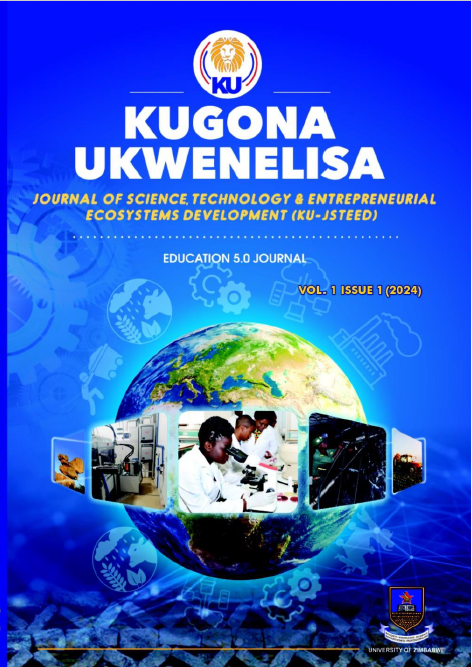
KUGONA UKWENELISA
Vol. 1 No. 1 (2024)Kugona-Ukwenelisa: Journal of Science, Technology and Entrepreneurial Ecosystems Development (KU-JSTEED) is a biannual publication inspired by the heritage-based Education 5.0 Philosophy as a new paradigm for an education purpose to deliver goods and services that meet the development aspirations of individuals, communities and nations. KU-JSTEED harnesses and communicates the finest science, technology and innovations at local, national, regional and global scales to develop science- and technology-based solutions, and advance sustainable socio-ecological, industrial and business ecosystems development, and improve the quality of life. KU-JSTEED fosters critical thinking and cutting-edge research to build knowledge through science and innovation, and bring value for evidence-based knowledge. Enquiries can be directed to the proxy Editor-in-Chief through the following email address: ku-jsteed@uzlib.uz.ac.zw. KU-JSTEED accepts article or paper submissions through the same email address during submission timelines defined by circulated calls for papers.